
 English
 Pусский
 한국어
한국어 हिन्दी
シェルアンドチューブ熱交換器
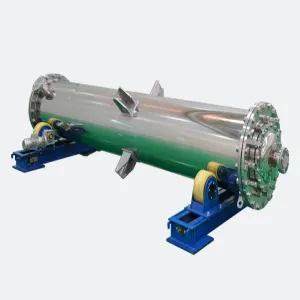
A shell and tube heat exchanger is one of the most common and widely used types of heat transfer equipment in industrial applications. It is designed to transfer heat between two fluids, usually without allowing them to mix. The basic structure consists of a cylindrical shell, a bundle of tubes inside the shell, tube sheets at both ends, and various internal components that guide the flow of fluids. One fluid flows through the tubes, while the other flows around the tubes inside the shell. Because the fluids remain separated by the tube walls, heat is transferred efficiently from one fluid to the other.This type of heat exchanger is popular because it is simple in principle, reliable in operation, and suitable for high-pressure and high-temperature environments. It can be used for heating, cooling, condensation, and evaporation processes. Shell and tube heat exchangers are found in many industries, including power generation, chemical processing, oil refining, food production, and HVAC systems. Their versatility makes them a practical choice for a wide range of thermal applications.The working principle is based on temperature difference. When a hot fluid and a cold fluid pass through the exchanger, heat naturally moves from the hotter side to the cooler side. The rate of heat transfer depends on several factors, such as fluid temperature, flow arrangement, heat transfer area, and material properties. To improve performance, the tubes are often arranged in multiple passes, and baffles are installed inside the shell to direct the fluid flow. Baffles help increase turbulence, which improves heat transfer and supports the tubes mechanically.There are several important design variations of shell and tube heat exchangers. The flow arrangement may be counterflow, parallel flow, or crossflow, with counterflow often providing the highest thermal efficiency. The tubes may be fixed, U-shaped, or floating, depending on operating conditions and maintenance requirements. Different materials can also be selected, such as stainless steel, carbon steel, copper alloys, or titanium, to suit the fluid type and operating environment.One major advantage of shell and tube heat exchangers is their durability. They can handle large volumes of fluid and operate under harsh conditions. They are also relatively easy to clean and maintain, especially when designed with removable tube bundles. However, they may be larger and heavier than some other heat exchanger types, and they can be less compact. In addition, if scaling or fouling occurs, heat transfer efficiency may decrease over time.Overall, the shell and tube heat exchanger remains an essential piece of industrial equipment. Its strong construction, flexible design, and dependable performance make it suitable for many thermal systems. As industries continue to require efficient energy use and reliable process control, this type of heat exchanger will remain an important solution for heat transfer applications.
製品
カテゴリー:
-
熱交換器
彼らの分類: ろ過・熱交換装置ビュー: 194番号:解放時間: 2026-06-08 09:52:53熱交換器は、2 つの流体を混合することなく効率的に熱エネルギーを伝達するために設計された重要な産業用デバイスです。熱交換器は化学処理、石油とガス、食品製造、製薬、半導体産業で広く使用されており、安定した温度制御、エネルギー効率、プロセスの安全性を保証します。一般的なタイプには、シェルアンドチューブ、プレート、スパイラル、空冷設計があり、それぞれが異なる動作条件に適しています。 Jiangsu Jiexin New Materials Co., Ltd. は、耐久性、効率、長期的な動作信頼性を必要とする要求の厳しい産業用途向けに設計された、耐食性と PTFE ライニング システムを含む高性能熱交換器ソリューションを提供しています。
ニュース
カテゴリー:
-
[industry news]What points should be focused on when procuring PTFE equipme...
2026-08-07 03:26:58
ケース
カテゴリー:
検索結果はありません!
ビデオ
カテゴリー:
検索結果はありません!
ダウンロード
カテゴリー:
検索結果はありません!
採用
カテゴリー:
検索結果はありません!
おすすめ商品
検索結果はありません!



 ワッツアップ
 電話
電話